⚔️ Fast16 Malware Sabotaged Nuclear Weapons Tests:...
On this page
- Breaking News Summary
- What Is Fast16 Malware?
- How Fast16 Sabotaged Nuclear Weapons Tests
- Why This Is a Turning Point in Cyber Warfare
- What This Means for Personal Cybersecurity
- 3 Immediate Steps to Protect Your Digital Life
- The Bigger Picture: State-Level Cyber Operations in 2026
- Recommended Security Tools for 2026
- Frequently Asked Questions
- Timeline of Events
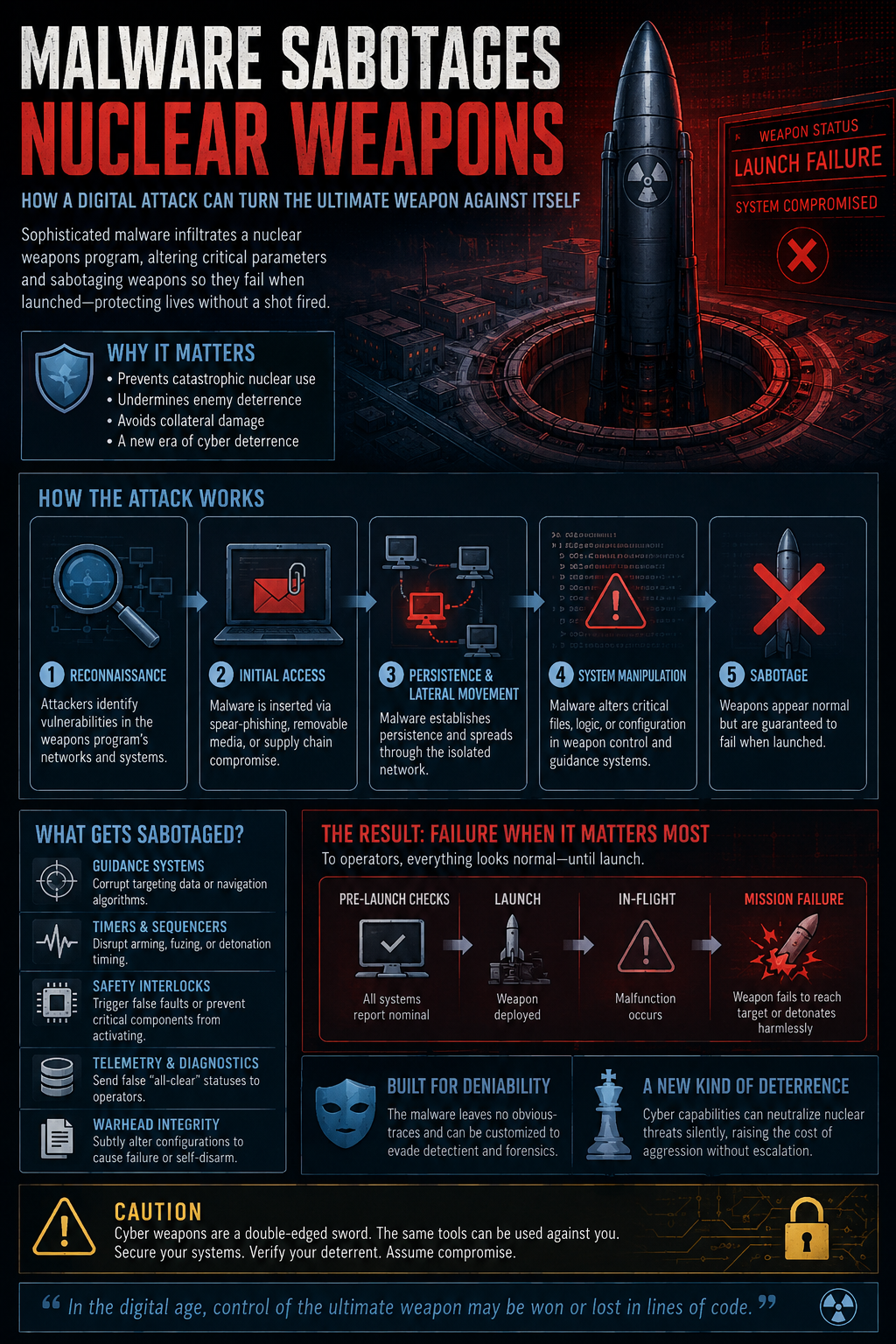
Breaking: Security researchers have confirmed that the Fast16 malware — a sophisticated state-level cyber weapon — was actively sabotaging nuclear weapons testing operations. The malware infiltrated test equipment and instrumentation systems, manipulating readings and causing test failures. It's believed to have targeted nuclear weapons development programs, likely in Iran. This represents a major escalation in cyber warfare capabilities — moving from espionage to active sabotage of weapons systems.
Breaking News Summary
Date: May 2026
Malware: Fast16
Target: Nuclear weapons testing facilities
Suspected origin: State-sponsored (attribution ongoing)
Impact: Sabotaged weapons test equipment, manipulated instrumentation data, caused failed tests
Significance: First confirmed use of malware to disrupt nuclear weapons development programs
This isn't a theoretical threat. Fast16 crossed the Rubicon of cyber warfare — it went from stealing secrets to actively sabotaging the most sensitive military infrastructure on the planet.
What Is Fast16 Malware?
Fast16 is a modular, persistent malware strain designed specifically for industrial control system (ICS) infiltration. Unlike general-purpose malware, Fast16 was built to:
- Target specialized scientific instrumentation used in nuclear test environments
- Manipulate sensor readings — making test equipment report normal values when it was being tampered with
- Persist across system reboots — deeply embedded in firmware and boot processes
- Exfiltrate test data — stealing detailed technical specifications of weapons designs
- Self-destruct — wipe traces after mission completion to hinder forensic analysis
The malware's sophistication suggests it was developed by a well-resourced state actor with deep knowledge of nuclear testing infrastructure.
How Fast16 Sabotaged Nuclear Weapons Tests
The attack chain is a masterclass in operational security:
Phase 1: Initial Infiltration
The attackers compromised the software supply chain of specialized test equipment manufacturers. Fast16 was embedded in firmware updates that were digitally signed — making them appear legitimate.
Phase 2: Lateral Movement
Once inside the test facility's network, Fast16 used legitimate administrative QR Code Generator tools (living-off-the-land techniques) to move from IT systems to operational technology (OT) systems — the actual test instrumentation.
Phase 3: Test Manipulation
During live weapons tests, Fast16 would: 1. Intercept sensor data from diagnostic equipment 2. Modify readings to show expected values instead of actual measurements 3. Trigger test failures at critical moments by sending false commands to control systems 4. Mask failures — operators saw normal telemetry while the test was being actively sabotaged
Phase 4: Exfiltration
Stolen data — including detailed weapons test metrics, yield calculations, and design adjustments — was securely exfiltrated to command-and-control servers.
Phase 5: Cleanup
After achieving its objectives, Fast16 would erase log entries, wipe forensic evidence, and in some cases, render the test equipment permanently inoperable.
Why This Is a Turning Point in Cyber Warfare
Cyber attacks on critical infrastructure aren't new — we've seen the Stuxnet attack on Iranian centrifuges (2010), the Colonial Pipeline ransomware (2021), and the Viasat satellite attack (2022). But Fast16 represents something fundamentally different:
| Attack | Year | Target | Impact |
|---|---|---|---|
| Stuxnet | 2010 | Uranium centrifuges | Physical destruction |
| Colonial Pipeline | 2021 | US fuel pipeline | Operational shutdown |
| Viasat | 2022 | Satellite communications | Service disruption |
| Fast16 | 2026 | Nuclear weapons tests | Weapons program sabotage |
What makes Fast16 historic is the combination of espionage, manipulation, and destruction in a single, long-term operation. The malware wasn't designed for a one-time impact — it was designed to stay, learn, and systematically sabotage over months or years.
This brings us closer to what security experts have long warned about: a full-spectrum cyber weapon capable of active, long-term disruption of military capabilities.
What This Means for Personal Cybersecurity
While the Fast16 operation targets nation-state levels, the implications for everyday users are significant:
1. State-level threat actors now target supply chains
If a nuclear test facility can't trust its firmware updates, how safe is your smartphone's OS update? The supply chain compromise vector is now normalized at the highest level.
2. Zero-trust architecture is the only defense
Fast16 could only achieve its goals because test instrumentation implicitly trusted signed firmware updates. The same principle applies to your personal security: trust nothing, verify everything.
3. Critical infrastructure failures cascade
When state actors test capabilities against nuclear facilities, the knowledge they gain is eventually used against softer targets — utilities, hospitals, and businesses. The techniques that worked on nuclear test beds will be adapted for broader attacks.
4. Encryption and privacy tools are your first line of defense
In an era where state actors compromise hardware and firmware, your best protection is: - VPN — encrypts your traffic so attackers can't intercept it at the network level - Password manager — ensures unique credentials so a single supply chain compromise doesn't cascade - Multi-factor authentication — protects accounts even if credentials are stolen
3 Immediate Steps to Protect Your Digital Life
Step 1: Use a VPN for All Traffic
A VPN like NordVPN encrypts your internet connection, making it significantly harder for attackers to intercept or manipulate your data. This is crucial whether you're working remotely, browsing at home, or using public WiFi.
Why it matters: If Fast16's operators can compromise nuclear test equipment over a network, they can certainly intercept unencrypted traffic. VPN encryption renders that type of attack ineffective against your personal data.
Step 2: Secure Your Accounts with a Password Manager
Use 1Password or NordPass to generate and store unique, complex passwords for every account. This prevents credential-stuffing attacks and limits the damage if any single service is compromised.
Why it matters: Supply chain attacks like Fast16's initial vector can compromise any software vendor. Unique passwords mean a breach at one service doesn't cascade to others.
Step 3: Install Multi-Layered Endpoint Protection
Bitdefender or Malwarebytes provide real-time protection against malware, including zero-day threats. Modern antivirus suites include behavior-based detection that can identify and block novel threats.
Why it matters: State-level malware like Fast16 is designed to evade traditional signature-based detection. Behavioral analysis catches anomalies even when there's no known signature.
The Bigger Picture: State-Level Cyber Operations in 2026
Fast16 isn't happening in isolation. May 2026 has seen an unprecedented wave of cyber operations:
- FBI scrubs Russian GRU malware from thousands of home routers
- BitLocker encryption bypassed — full disk encryption vulnerability confirmed
- OpenAI hit with class-action privacy lawsuit over data sharing with Google and Meta
- cPanel mass exploit — 44,000+ servers compromised
- 4th critical Linux kernel flaw this month (SSH host key theft)
The common thread? Offensive cyber capabilities are accelerating faster than defensive measures can keep up. Every new vulnerability, every state-sponsored operation, and every data breach proves that reactive security isn't enough — you need proactive, layered protection.
Recommended Security Tools for 2026
| Layer | Recommended Tool | Price | What It Protects |
|---|---|---|---|
| 🛡️ VPN | NordVPN | $3.49/mo | Encrypts all internet traffic |
| 🛡️ VPN (Premium) | ExpressVPN | $6.67/mo | High-speed, no-logs privacy |
| 🔒 Antivirus | Bitdefender | $29.99/yr | Malware, ransomware, exploits |
| 🔑 Password Manager | 1Password | $2.99/mo | Unique credentials for every account |
| 🔑 Password Manager (Free) | Bitwarden | Free | Secure credential management |
Strengthen Your Password Security
After applying the recommendations in this guide, use our Best Password Generator to create strong, unique passwords for all your accounts. Browse our cybersecurity blog for more security guides and industry updates. You can also generate secured QR codes with our QR Code Generator tool.
Frequently Asked Questions
Is Fast16 still active?
Parts of the Fast16 infrastructure are believed to be active. Researchers continue to track command-and-control servers and identify compromised systems. The operation was likely multi-phased, and not all phases may have been neutralized.
Was the US the target?
Attribution is ongoing, but the malware's operational focus and technical characteristics suggest it was targeting a nation's nuclear weapons program, likely Iran. However, the techniques used could be adapted to target any nation's critical infrastructure.
Should I be worried about this affecting my personal devices?
Directly — no. Fast16 was designed for highly specific industrial control systems, not consumer devices. Indirectly — yes. The supply chain compromise techniques used by Fast16 operators will inevitably be adapted for broader attacks.
How does this compare to Stuxnet?
Fast16 is in some ways more sophisticated than Stuxnet. While Stuxnet caused physical destruction (centrifuge breakdowns), Fast16 combines espionage, data manipulation, and operational sabotage — making it harder to detect and more versatile as a weapon.
What does this mean for nuclear non-proliferation?
This is a significant development. Cyber sabotage of weapons testing raises questions about the reliability of nuclear test data and the confidence that nations can have in their weapons programs. It also opens new possibilities for non-proliferation through cyber means.
Timeline of Events
| Date | Event |
|---|---|
| ~2024 | Fast16 believed to have been deployed via compromised firmware updates |
| Early 2026 | First anomalous test failures reported |
| Mid-2026 | Independent researchers identify malware patterns in test instrumentation |
| May 17, 2026 | Public disclosure of Fast16 as nuclear test sabotage malware |
| Present | Attribution and cleanup operations ongoing |
Disclosure: This article contains affiliate links. We may earn a commission if you purchase through our links — at no extra cost to you. We only recommend products we have tested and genuinely believe in.
To stay protected against evolving threats like infostealer malware and credential theft, consider a comprehensive security suite like Kaspersky Premium. It includes advanced malware protection, password monitoring, and breach alerts that help you detect compromised credentials early.