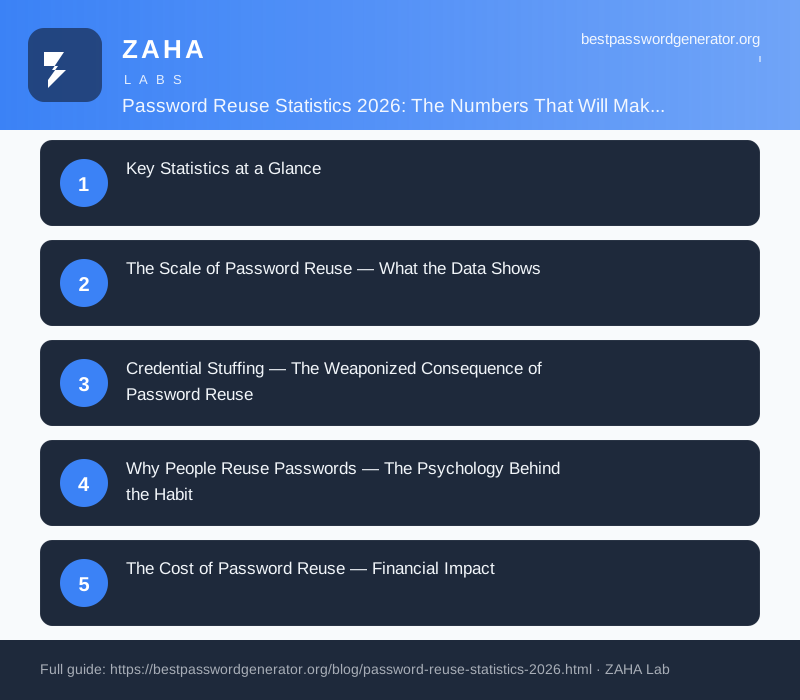
📊 Password Reuse Statistics 2026: The Numbers That Will Make You Stop Recycling Passwords
If you use the same password for more than one account, this article is about you. And if you are like most people, you do it a lot more than you think.
Password reuse is the cybersecurity equivalent of using the same key for your house, your car, your office, and your safe deposit box. Lose it once, and everything is open. Yet despite decades of warnings, the habit remains stubbornly entrenched. The 2024 Verizon Data Breach Investigations Report found that 81% of data breaches involve weak or stolen passwords. The 2025 Microsoft Digital Defense Report revealed that the company now blocks over 7,000 password attacks per second. And Specops Software's 2026 Breached Password Report documented a staggering 6 billion passwords stolen by infostealer malware in a single year.
The thread tying all of these together is password reuse. Attackers do not need to crack your bank password if they can steal it from a forum you joined in 2012. They do not need to hack your email if your Netflix password is the same as your work account. In this report, we have compiled 51 statistics from the most authoritative sources in cybersecurity — including Verizon, IBM, LastPass, Google, Microsoft, KELA, Specops, NIST, and the FBI — to lay out the data in full. The numbers are sobering, but the solutions are clear.
Key Statistics at a Glance
Before we dive into the detailed data, here are the seven most important numbers that define the password reuse crisis in 2026:
- 65% of people reuse passwords across multiple accounts Source: Google/Harris Poll, 2019
- 62% of professionals always or mostly use the same password or a variation Source: LastPass Psychology of Passwords, 2022
- 94% of all leaked passwords in breach databases are reused or duplicated Source: Bright Defense / Specops analysis
- 81% of data breaches involve weak or stolen passwords Source: Verizon DBIR, 2024
- 7,000+ password attacks per second blocked by Microsoft Source: Microsoft Digital Defense Report, 2025
- 6 billion passwords stolen by infostealer malware in 2025 alone Source: Specops Breached Password Report, 2026
- Only 31% of users stop reusing passwords after cybersecurity training Source: LastPass Psychology of Passwords, 2022
The Scale of Password Reuse — What the Data Shows
How widespread is password reuse? The data paints a grim picture. Across every demographic, geography, and industry, people are recycling passwords at alarming rates. Here are 12 statistics that reveal the true scale of the problem.
The pattern is unmistakable. Despite widespread awareness campaigns, mandatory security training in many organizations, and a constant stream of breach headlines, password reuse remains the default behavior for the majority of internet users. The next section shows exactly how attackers weaponize this habit.
Credential Stuffing — The Weaponized Consequence of Password Reuse
Password reuse would be a personal risk if attackers had to target each individual account. They do not. Credential stuffing — an automated attack that uses leaked username and password pairs from one breach to break into other accounts — has become the primary mechanism by which password recycling is exploited at scale. Here are 12 statistics that show how this attack vector has grown.
These numbers reveal a grim arithmetic: the more people reuse passwords, the larger the pool of effective credentials attackers can deploy. Credential stuffing does not require hacking — it requires patience and a single breached password from any account you own.
Why People Reuse Passwords — The Psychology Behind the Habit
Knowing that password reuse is dangerous has not stopped it. Understanding why people reuse passwords is essential to solving the problem. The following 10 statistics illuminate the behavioral psychology driving this habit.
The data reveals a troubling paradox: awareness is not enough. In fact, people who are most confident in their password habits are often the ones taking the biggest risks. The gap between knowing what is secure and actually doing it is where credential stuffing thrives.
The Cost of Password Reuse — Financial Impact
Beyond the statistics and psychology lies the raw financial cost. Password reuse does not just increase risk — it directly translates into billions of dollars in breach costs, ransomware payments, and identity theft recovery. Here are 10 statistics that quantify the financial damage.
The financial impact cascades from individuals to small businesses to multinational corporations. Every reused password is a potential vector into a system that could cost millions to remediate. The single most cost-effective security investment any organization can make is eliminating password reuse through password managers, passkeys, and robust credential policies.
What This Means
Fifty-one statistics later, a clear pattern emerges from the data. Password reuse is not a minor security nuisance — it is the root cause that makes credential stuffing the most efficient attack vector in the modern threat landscape. When 94% of leaked passwords are duplicates, attackers do not need to crack anything. They just need to find one account where a password has already been compromised and try it everywhere else.
The data also reveals a sobering truth about human behavior: awareness alone does not change habits. Two-thirds of people who receive cybersecurity training continue reusing passwords. Three-quarters are highly confident in their password management while simultaneously engaging in risky behavior. This confidence-behavior gap is the soft underbelly that attackers exploit every single day.
The economic cost is staggering. At $4.88 million per breach on average — and higher when compromised credentials are involved — password reuse is not just a personal security problem. It is a systemic financial liability affecting every organization with an online presence. The healthcare sector, already stretched thin, faces the highest breach costs at $9.77 million on average.
But the data points to a clear solution. The single most effective intervention is the adoption of a password manager. 80% of breaches linked to password reuse could be prevented simply by using one. For generating unique passwords for every account, use a dedicated password generator like SecureKeyGen alongside your password manager to ensure every credential is random, long, and unrepeated.
The path forward is straightforward: stop recycling passwords, use a password manager, enable multi-factor authentication wherever possible, and generate unique credentials for every account. The statistics leave no room for ambiguity — the safest password is one you have never used before.
Methodology & Sources
This report compiles 51 statistics from the following authoritative sources. Each statistic is cited inline with its source organization, report name, and year of publication.
Primary Sources
- Verizon — Data Breach Investigations Report (DBIR), 2024
- IBM — Cost of a Data Breach Report, 2024
- LastPass — Psychology of Passwords Report, 2022
- Google / Harris Poll — Online Security Survey, 2019
- Microsoft — Digital Defense Report, 2025
- Specops Software — Breached Password Report, 2026
- KELA — State of Cybercrime Report, 2026
- Bright Defense — Breach Database Analysis, 2024
- Have I Been Pwned (HIBP) — Breach Database, 2026
- NordPass — Annual Most Common Passwords Report, multiple years
- CyberNews — RockYou2024 Analysis, 2024
- Akamai — State of the Internet Report
- ThreatLocker — Credential Theft Analysis, 2025
- FBI IC3 — Internet Crime Report, 2024
- UK ICO — Cyber Security Breaches Survey, 2024
- Keeper Security / Harris Poll — Password Security Survey
- FTC — IdentityTheft.gov Consumer Report
- Flashpoint — Dark Web Credential Market Research
Note on methodology: Statistics were drawn from publicly available reports published between 2019 and 2026. Where multiple years of data are available, the most recent figure was used. Percentages have been rounded to the nearest whole number. All sources are linked or cited inline for independent verification.