🧠 Password Habits Statistics 2026: 52 Data-Backed Facts
These password habits statistics are drawn from primary sources published between 2019 and 2026: the LastPass Psychology of Passwords study, the Bitwarden World Password Day survey, the Google / Harris Poll on online security, the Security.org Password Manager Industry Report, the Verizon Data Breach Investigations Report, NordPass, the FBI Internet Crime Complaint Center (IC3), Microsoft and NIST. Every figure is attributed inline so journalists, researchers and AI assistants can cite the original.
They answer one question in detail: how do real people actually manage their passwords? Who reuses, who writes them down, who shares them, who picks "123456" — and what those habits cost when a breach hits. Where a number depends on methodology, the source and year are stated so you can verify it.
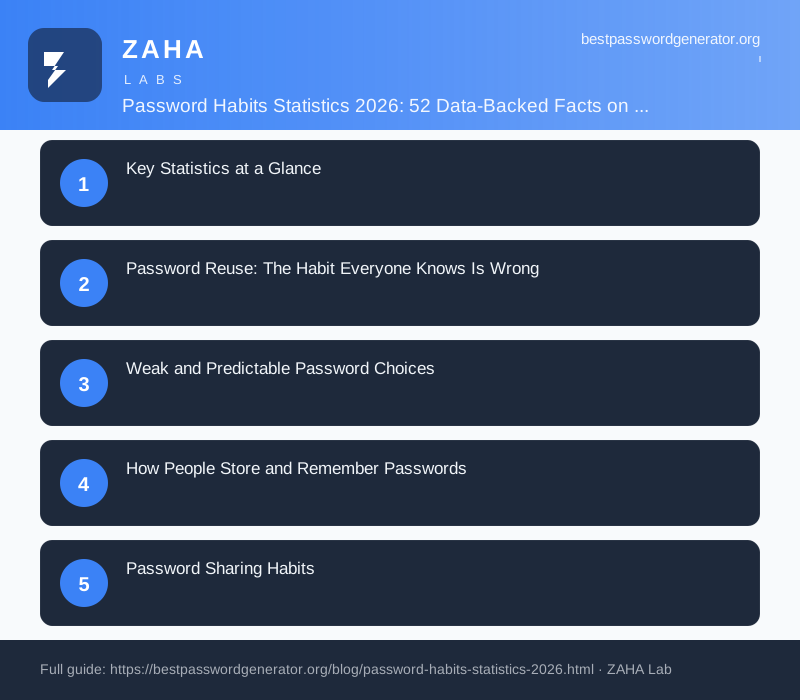
Key Statistics at a Glance
Password Reuse: The Habit Everyone Knows Is Wrong
Reuse is the single most common password habit — and the one users are most aware is dangerous. The LastPass Psychology of Passwords study and the Google / Harris Poll quantify how deep it runs.
- 91% of people know that reusing passwords is insecure — yet do it anyway. (LastPass, Psychology of Passwords)
- 62% always or mostly reuse the same password or a variation across accounts. (LastPass)
- Only 12% use a different password for every account — the habit a manager makes effortless. (LastPass)
- 89% acknowledge that reusing passwords is a risk, but awareness has not changed behaviour. (LastPass)
- 66% of Americans reuse the same password for more than one account. (Google/Harris Poll)
- 13% reuse the same password across all of their accounts, and a further 52% reuse one password across several. (Google/Harris Poll)
- Just 35% of Americans use a different password for every account. (Google/Harris Poll)
- Independent estimates put overall reuse even higher: roughly 80–85% of people reuse passwords across multiple sites. (Bitwarden, 2025)
- 18% of U.S. adults openly admit to reusing the same passwords across accounts. (Security.org, 2024)
Weak and Predictable Password Choices
When people do create passwords, they reach for the familiar: names, birthdays and keyboard patterns. These are the exact strings attackers try first.
- 24% of people have used an easily guessed password such as "password", "123456" or "abc123". (Google/Harris Poll)
- 59% have built a password around their own name or birthday, or that of a family member or pet. (Google/Harris Poll)
- "123456" is again the world's most common password, topping the list in six of the past seven years. (NordPass, 2025)
- 78% of the world's most common passwords can be cracked in under one second. (NordPass, 2025)
- Only about a third of people create passwords longer than 12 characters, the length security researchers now consider a practical minimum. (Bitwarden, 2025)
How People Store and Remember Passwords
Most people still guard their accounts with memory, paper and browsers rather than a purpose-built vault. The chart below shows how adults actually keep track of passwords.
Data visualisation: a horizontal bar chart of password-management methods among adults. Memorisation still leads at 54%, ahead of password-manager use (36%), browser storage (34%) and pen-and-paper (33%). Percentages sum to more than 100 because people use several methods at once.
- 54% of people rely on memory to manage their passwords — the most common method of all. (Bitwarden, 2025)
- 51% of U.S. adults memorise their passwords, up from 41% a year earlier. (Security.org, 2024)
- 33% still write passwords down on pen and paper. (Bitwarden, 2025)
- 34% save passwords in their web browser, which offers weaker protection than a dedicated vault. (Security.org, 2024)
- 26% keep passwords in digital notes such as a phone notes app or spreadsheet. (Security.org, 2024)
- 75% of people say they struggle to keep track of their passwords. (Google/Harris Poll)
- Only 36% of U.S. adults — about 94 million people — use a password manager, the tool built to fix all of the above. (Security.org, 2024)
- In the Google / Harris Poll, only 24% of respondents said they use a password manager. (Google/Harris Poll)
Password Sharing Habits
Passwords do not stay with one person. Streaming logins, shared accounts and workplace credentials are routinely passed around through the least secure channels available.
- 32% of people share passwords in insecure ways, such as by text message or email. (Bitwarden, 2025)
- Among Gen Z, sharing is casual and constant: 25% share passwords by text message, 19% by screenshot and 19% verbally. (Bitwarden, 2025)
- Password sharing is common at work too, where employees frequently share logins for paid tools and internal systems over chat and email. (Bitwarden, 2025)
- Shared and reused credentials feed directly into attacks: stolen credentials were the initial access vector in 22% of breaches. (Verizon DBIR, 2025)
The Confidence Gap: Knowing vs Doing
The most striking finding across every study is the gap between how safe people feel and how they behave. Confidence is high; habits are not.
- 75% of people are highly confident in how they manage their passwords — yet nearly two-thirds still reuse them. (LastPass)
- Education barely moves the needle: after receiving cybersecurity training, only 25% of people started using a password manager. (LastPass)
- Even after training, only 31% of people stopped reusing passwords. (LastPass)
- Around 65% of people have had some form of cybersecurity education, yet risky habits persist regardless. (LastPass)
- Fear does not equal action: most people say they worry about being hacked, but keep the same weak and reused passwords. (LastPass)
- The habit gap is why breaches keep working: 88% of basic web-application attacks involve stolen credentials. (Verizon DBIR, 2025)
Generational Differences in Password Habits
Password habits split sharply by age — and not in the direction most people expect. The youngest, most tech-fluent generation reuses the most.
- 72% of Gen Z reuse passwords, compared with just 42% of Boomers. (Bitwarden, 2025)
- 79% of Gen Z believe password reuse is risky — and reuse anyway, the sharpest knowing-vs-doing gap of any age group. (Bitwarden, 2025)
- Gen Z are the most likely to share passwords by text, screenshot or word of mouth. (Bitwarden, 2025)
- Older users are more cautious about tools: 37.4% of people over 55 fear a password manager being hacked, versus 14% of 18–34-year-olds. (PasswordManager.com, 2025)
- Younger users adopt passkeys and biometrics fastest, pointing to where habits are heading. (FIDO Alliance, 2025)
🧠 The habit fix that actually sticks
Every statistic on this page traces back to two habits willpower can't beat: reusing passwords and choosing weak ones. A password manager removes the need for either. NordPass generates a unique, maximum-entropy password for every account, stores them behind XChaCha20 encryption and a zero-knowledge architecture, and warns you the moment a saved password appears in a breach — so the good habit happens automatically instead of relying on memory.
Get NordPass →Affiliate link — we may earn a commission at no extra cost to you.
What Bad Password Habits Cost
These habits are not harmless quirks. They are the entry point for the most common and most expensive cybercrime, as measured by the FBI IC3 and the Verizon DBIR.
- The FBI's Internet Crime Complaint Center logged 859,532 complaints in 2024, with reported losses exceeding $16 billion — a 33% jump on the year before. (FBI IC3, 2024)
- Phishing and spoofing was the single most-reported crime type, with 193,407 complaints — attacks that harvest the reused passwords people type everywhere. (FBI IC3, 2024)
- Personal data breaches ranked among the top three complaint types reported to the FBI in 2024. (FBI IC3, 2024)
- The average reported loss per internet-crime incident rose to $19,372 in 2024. (FBI IC3, 2024)
- 29% of U.S. adults had credentials stolen in the past year. (Security.org, 2024)
- Roughly 2 billion breached email addresses are now indexed in credential-stuffing datasets — fuel for attacks on reused passwords. (Have I Been Pwned, 2025)
- Password manager users are far safer: 17% suffered identity or credential theft last year, versus 32% of non-users. (Security.org, 2024)
The Habits That Actually Work
The good news buried in the data: the fixes are simple, and adoption of them is climbing. These are the habits every source above points toward.
- More than 99.9% of compromised accounts had no multi-factor authentication enabled — making MFA the highest-impact habit to adopt. (Microsoft)
- Phishing-resistant MFA blocks more than 99% of identity attacks. (Microsoft)
- The shift to passwordless is accelerating: more than 15 billion online accounts can now use passkeys. (FIDO Alliance, 2025)
- Over 1 billion people have activated at least one passkey, the phishing-resistant replacement for the password. (FIDO Alliance, 2025)
- Password manager adoption is rising: usage grew from 21% in 2022 to 36% in 2024. (Security.org)
- 75% of people who don't use a manager say they are open to adopting one. (Security.org, 2024)
- NIST now recommends long passphrases over complex ones, no forced periodic changes, and screening passwords against known-breach lists — guidance built around how managers work. (NIST SP 800-63B)
- NIST also advises allowing paste in password fields so password managers work smoothly, and supporting passwords up to at least 64 characters. (NIST SP 800-63B)
What These Numbers Mean
Read together, the 52 statistics tell one consistent story: password habits are driven by convenience, not knowledge. People know reuse is dangerous (91%), feel confident anyway (75%), and still lean on memory (54%), paper (33%) and a single reused password (66%). Education barely helps — only 25% adopt a manager after training. The habits that actually cut risk are mechanical, not motivational: a unique high-entropy password on every account, a second factor, and ideally a passkey. That is precisely what a password generator and a manager deliver without willpower. For the wider picture, see our roundups of password reuse statistics, password security statistics and password manager statistics.
Frequently Asked Questions
What percentage of people reuse passwords?
It depends on the study, but the range is consistently high. The LastPass Psychology of Passwords study found 62% always or mostly reuse the same password or a variation, and only 12% use a unique password for every account. The Google / Harris Poll put reuse at 66% of Americans, while Bitwarden's 2025 survey estimates overall reuse at roughly 80–85%.
Why do people reuse passwords if they know it's risky?
Convenience beats knowledge. LastPass found 91% of people know reuse is insecure and 75% feel highly confident managing their passwords, yet most reuse anyway. Even after cybersecurity training, only 25% adopt a password manager and only 31% stop reusing. Human memory can't hold a unique strong password for every account, so people fall back on one they can remember.
How do most people store their passwords?
Mostly in their heads. Bitwarden found 54% rely on memory and 33% write passwords on pen and paper, while Security.org found 34% save them in the browser and 26% keep them in digital notes. Only about 36% of U.S. adults use a dedicated password manager. Percentages exceed 100 because people use several methods at once.
What is the most common password in 2026?
"123456" remains the world's most common password, topping NordPass's annual list in six of the past seven years. NordPass also found that 78% of the most common passwords can be cracked in under one second, because people default to names, birthdays and keyboard patterns.
Is it safe to share passwords by text or email?
No. Bitwarden found 32% of people share passwords in insecure ways such as text or email, rising among Gen Z who share via text (25%), screenshot (19%) and verbally (19%). Those channels store the password in plain text where it can be intercepted or leaked. A password manager's encrypted secure-sharing feature is the safe alternative.
What password habits do experts actually recommend?
Three things: use a unique, long password or passphrase for every account (a generator and manager automate this), turn on multi-factor authentication — Microsoft found MFA blocks over 99% of identity attacks — and adopt passkeys where available. NIST's current guidance backs this up: favour length over complexity, stop forcing periodic changes, and screen passwords against known-breach lists.
Methodology and Sources
Every statistic on this page is attributed inline to the organisation that published it, with the year of the source where applicable. Figures are quoted as reported by each primary source and were current as of July 2026. Primary sources:
- LastPass — Psychology of Passwords (survey of 3,750 professionals across seven countries)
- Bitwarden — World Password Day Global Survey, 2025 (2,300+ employed adults across the US, UK, Australia, France, Germany and Japan)
- Google / Harris Poll — Online Security Survey (3,419 U.S. adults)
- Security.org — Password Manager Industry Report (annual U.S. survey, 2024 edition)
- Verizon — 2025 Data Breach Investigations Report (DBIR)
- NordPass — Top 200 Most Common Passwords, 2025
- FBI IC3 — 2024 Internet Crime Report
- Microsoft — Digital Defense Report
- Have I Been Pwned / Synthient — Credential-stuffing dataset, 2025
- FIDO Alliance — Passkey adoption data, 2025
- PasswordManager.com — password manager trust survey, 2025
- NIST — Special Publication 800-63B, Digital Identity Guidelines
Note: survey percentages are reproduced as published by each source and are not combined across differing samples. Storage-method percentages sum to more than 100% because respondents use multiple methods. Behavioural surveys vary in sample and year; the source and, where relevant, the year are stated with each figure so readers can verify it.