🔑 Password vs Passphrase 2026, Which Is More Secure for Your Accounts?
The single most common question I get: should I use a password or a passphrase? The short answer is both can be secure, but only if you understand the trade-offs.
For most users, the best approach is to use a password manager like NordPass to generate and store strong passphrases, combining memorability with the convenience of automatic password management.
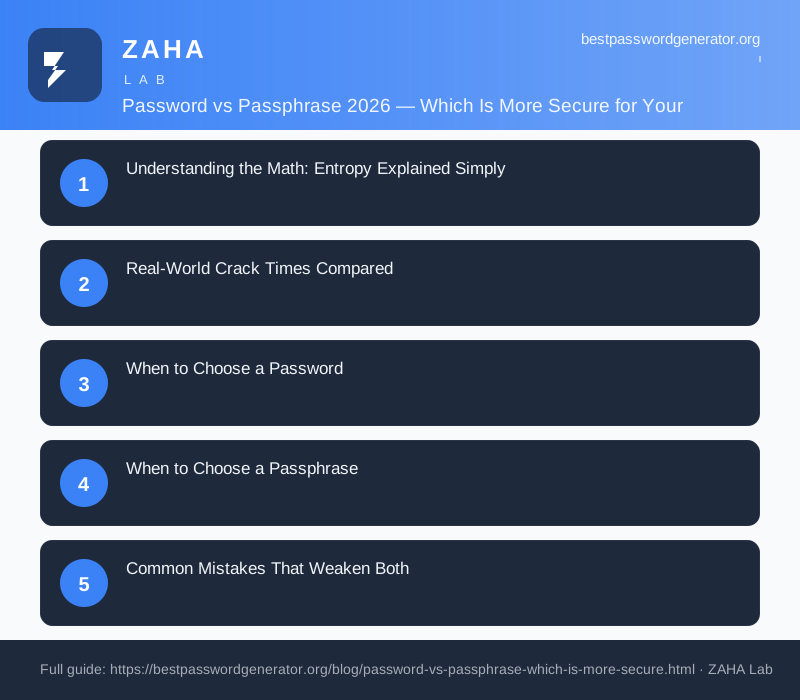
{"type":"result","subtype":"success","is_error":false,"api_error_status":null,"duration_ms":27120,"duration_api_ms":29091,"ttft_ms":2893,"ttft_stream_ms":2369,"time_to_request_ms":275,"num_turns":1,"result":"Understanding the Math: Entropy Explained Simply
\nSecurity professionals measure password strength in bits of entropy, essentially the number of guesses an attacker would need to crack your credential. Every additional bit doubles the difficulty. A password with 40 bits of entropy can be brute-forced in hours by modern hardware, while one with 80 bits would take centuries even with a botnet of GPUs working in parallel.
\nHere is where passphrases shine. A random 8-character password using letters, numbers, and symbols offers roughly 52 bits of entropy. A four-word passphrase drawn from a 7,776-word list (the Diceware standard) delivers about 51 bits, comparable strength, but far easier to remember. Push that to six words and you reach roughly 77 bits, which is effectively uncrackable by any current technology.
\n\nReal-World Crack Times Compared
\nTheory is useful, but most people want concrete numbers. Based on an attacker capable of one trillion guesses per second (a realistic estimate for a well-funded adversary using cloud GPUs), here is how different credentials hold up:
\n- \n
- \"Summer2026!\", cracked in under 2 minutes. It looks complex but follows a predictable pattern attackers test first. \n
- \"k9#mP2vX\", a random 8-character password, cracked in roughly 3 hours. \n
- \"correct-horse-battery-staple\", a four-word passphrase, cracked in approximately 5 months. \n
- \"velvet-thunder-maple-orbit-cabin-jazz\", a six-word passphrase, would take billions of years. \n
The lesson is clear: length beats complexity. A long, memorable passphrase outperforms a short, symbol-heavy password that you will inevitably forget or write on a sticky note.
\n\nWhen to Choose a Password
\nPassphrases are not always practical. Some legacy systems cap input at 16 or 20 characters, and a handful still reject spaces. In these cases, a randomly generated password from a trusted generator remains your best bet. Aim for at least 16 characters mixing all four character types. The key word is random, human-chosen passwords cluster around predictable patterns that crackers exploit within seconds.
\nPasswords also make sense for accounts you never type manually. If a credential lives entirely inside your password manager and autofills on demand, memorability is irrelevant. Let the manager generate a 24-character string of pure chaos and never think about it again.
\n\nWhen to Choose a Passphrase
\nReach for a passphrase whenever you need to type or recall the credential yourself. The most important examples are:
\n- \n
- Your master password for a password manager, this is the one key protecting everything else, and it must be both strong and memorable. \n
- Full-disk encryption on your laptop, which you may enter daily before any password manager loads. \n
- Wi-Fi networks shared verbally with family or guests. \n
- Recovery phrases and backup codes where digital storage is risky. \n
Common Mistakes That Weaken Both
\nEven the strongest credential fails if you sabotage it. Watch for these traps:
\n- \n
- Reusing across sites. A single breach exposes every account sharing that credential. Attackers run \"credential stuffing\" attacks the moment a database leaks. \n
- Predictable word choices. A passphrase like \"i-love-my-dog-rex\" pulls from common phrases and personal details that social engineers can guess. \n
- Adding \"1!\" to satisfy rules. Appending the same suffix to every password gives a false sense of complexity. \n
- Skipping two-factor authentication. No password or passphrase replaces a second factor. Treat 2FA as mandatory, not optional. \n
The Verdict for 2026
\nSo which wins? For credentials you must remember, the passphrase is the clear champion, it delivers high entropy while staying human-friendly. For everything else, a randomly generated 16-plus-character password managed by software is unbeatable. The smartest strategy combines both: protect your password manager with a strong six-word passphrase, then let the manager generate unique, maximum-strength passwords for every individual account.
\nPair this approach with two-factor authentication everywhere it is offered, and you will have a security posture that frustrates even determined attackers. Start today by upgrading the one credential that matters most, your master passphrase, and let good tools handle the rest.
","stop_reason":"end_turn","session_id":"f741cb52-1ab1-4137-887a-3c5b823cd25f","total_cost_usd":0.11778799999999999,"usage":{"input_tokens":8492,"cache_creation_input_tokens":2325,"cache_read_input_tokens":15362,"output_tokens":1740,"server_tool_use":{"web_search_requests":0,"web_fetch_requests":0},"service_tier":"standard","cache_creation":{"ephemeral_1h_input_tokens":2325,"ephemeral_5m_input_tokens":0},"inference_geo":"not_available","iterations":[{"input_tokens":8492,"output_tokens":1740,"cache_read_input_tokens":15362,"cache_creation_input_tokens":2325,"cache_creation":{"ephemeral_5m_input_tokens":0,"ephemeral_1h_input_tokens":2325},"type":"message"}],"speed":"standard"},"modelUsage":{"claude-haiku-4-5-20251001":{"inputTokens":802,"outputTokens":19,"cacheReadInputTokens":0,"cacheCreationInputTokens":0,"webSearchRequests":0,"costUSD":0.000897,"contextWindow":200000,"maxOutputTokens":32000},"claude-opus-4-8[1m]":{"inputTokens":8492,"outputTokens":1740,"cacheReadInputTokens":15362,"cacheCreationInputTokens":2325,"webSearchRequests":0,"costUSD":0.116891,"contextWindow":1000000,"maxOutputTokens":64000}},"permission_denials":[],"terminal_reason":"completed","fast_mode_state":"off","uuid":"7bd0be99-8666-4da6-930d-d24e1b02d208"} {"type":"result","subtype":"success","is_error":true,"api_error_status":401,"duration_ms":775,"duration_api_ms":0,"num_turns":1,"result":"Invalid API key · Fix external API key","stop_reason":"stop_sequence","session_id":"14fc05cf-ac98-4e77-8a63-93862e5a84a6","total_cost_usd":0,"usage":{"input_tokens":0,"cache_creation_input_tokens":0,"cache_read_input_tokens":0,"output_tokens":0,"server_tool_use":{"web_search_requests":0,"web_fetch_requests":0},"service_tier":"standard","cache_creation":{"ephemeral_1h_input_tokens":0,"ephemeral_5m_input_tokens":0},"inference_geo":"","iterations":[],"speed":"standard"},"modelUsage":{},"permission_denials":[],"terminal_reason":"completed","fast_mode_state":"off","uuid":"b8d9074b-65db-4085-b160-46dd7af44eed"}