🎲 Password Entropy Explained: What It Is, How It's Calculated & Why It Matters
Almost every "password strength meter" you have ever seen is really trying to estimate one thing: entropy. It is the closest the security world has to an objective, mathematical measure of how hard a password is to guess. Yet it is widely misunderstood — people add a symbol, watch the meter turn green, and assume they are safe. This guide explains what password entropy actually is, shows the formula with worked examples, and answers the question that matters most: how many bits do you really need in 2026?
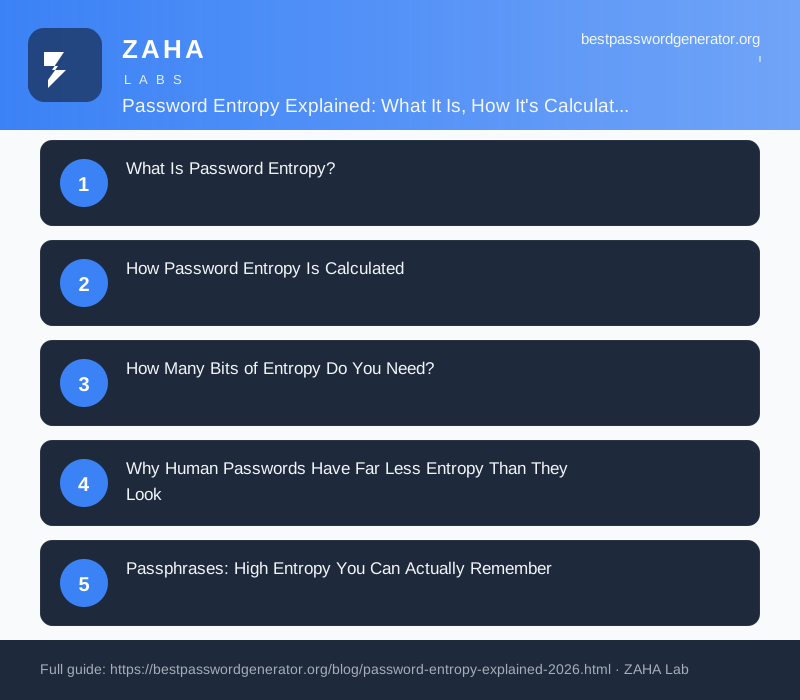
What Is Password Entropy?
The concept traces back to Claude Shannon, who introduced information entropy in his 1948 paper A Mathematical Theory of Communication and established the bit as the fundamental unit of information. Applied to passwords, entropy tells you the size of the "haystack" an attacker has to search. A 40-bit password lives in a haystack of about a trillion possibilities; a 60-bit password's haystack is a million times larger; an 80-bit password's is a trillion times larger still. That exponential growth is the whole point — and the reason a few extra random characters matter so much.
How Password Entropy Is Calculated
The formula for a randomly generated password is short:
Entropy (bits) = log₂(RL) = L × log₂(R)
where R is the size of the character pool (how many different symbols a character could be) and L is the length of the password. Because the exponent L comes down as a multiplier, length adds entropy far faster than complexity does. Each character drawn from a given pool contributes a fixed number of bits, shown below.
| Character set | Pool size (R) | Bits per character |
|---|---|---|
| Digits only (0–9) | 10 | 3.32 |
| Lowercase letters (a–z) | 26 | 4.70 |
| Upper + lowercase (A–Z, a–z) | 52 | 5.70 |
| Alphanumeric (A–Z, a–z, 0–9) | 62 | 5.95 |
| All printable ASCII (incl. symbols) | 95 | 6.57 |
To find a password's entropy, multiply its length by the bits-per-character value for its pool. A few worked examples make the pattern obvious:
- 8 lowercase letters → 8 × 4.70 = 37.6 bits (weak).
- 8 characters from the full ASCII set → 8 × 6.57 = 52.6 bits (still crackable).
- 12 characters, full ASCII → 12 × 6.57 = 78.8 bits (strong).
- 16 characters, full ASCII → 16 × 6.57 = 105.1 bits (very strong).
Notice that moving an 8-character password from lowercase-only to the full symbol set adds about 15 bits — but simply making it 12 characters instead of 8 adds far more. That is the mathematical case for length over complexity.
How Many Bits of Entropy Do You Need?
Entropy only becomes meaningful when you translate it into cracking time. The table below assumes an attacker who can make one trillion (1012) guesses per second — a realistic rate for a GPU cluster attacking a fast, poorly protected hash such as MD5 or SHA-1. "Average" crack time is half the total keyspace, because the right guess is found halfway through on average.
| Entropy | Example password | Avg. time to crack @ 1 trillion/sec |
|---|---|---|
| 28 bits | 6 lowercase letters | Instant (< 1 second) |
| 40 bits | ~8 lowercase letters | ~0.5 seconds |
| 50 bits | ~8 mixed characters | ~9 minutes |
| 60 bits | ~9 mixed characters | ~1 week |
| 70 bits | ~11 mixed characters | ~19 years |
| 80 bits | ~12 mixed characters | ~19,000 years |
| 100 bits | ~16 mixed characters | ~20 billion years |
| 128 bits | 7-word passphrase / crypto key | Longer than the universe has existed |
A practical reading of this table: aim for at least 60–70 bits for ordinary accounts and 80+ bits for anything valuable (email, banking, password-manager master password). Below 50 bits you are relying on the attacker not bothering; above 80 bits, brute force stops being a threat and the attacker has to try something else — phishing, malware, or a database breach.
Why Human Passwords Have Far Less Entropy Than They Look
Here is the trap. The log₂(RL) formula assumes every character is chosen independently and at random. Human-chosen passwords are nothing like that. We pick real words, names, dates, keyboard patterns and predictable substitutions — so an attacker never guesses blindly. They use dictionaries, breach lists and rules that model exactly how people behave.
Take P@ssw0rd1. By the naive formula it is 9 characters from a 95-symbol pool — about 59 bits, "strong" on paper. In reality it is one dictionary word with textbook substitutions and a trailing digit, and password-cracking tools try it almost immediately. Its real entropy is close to zero. This gap between theoretical and effective entropy is precisely why modern guidance stopped trusting complexity rules. As NIST Special Publication 800-63B puts it, "the length of a password has been found to be a primary factor in characterizing password strength," and the agency now recommends screening new passwords against known-breach lists rather than forcing symbol-and-number templates.
The lesson: entropy is only trustworthy when randomness is real. The reliable way to get the entropy the formula promises is to let software — a password generator — make the random choice for you, then store the result so you never have to memorise it.
Passphrases: High Entropy You Can Actually Remember
Random character strings maximise entropy per character but are miserable to type from memory. Passphrases solve this by drawing entropy from whole random words instead. The Electronic Frontier Foundation (EFF) publishes a Diceware word list of 7,776 words (6⁵), so each randomly selected word adds log₂(7,776) = 12.9 bits of entropy. String several together and the numbers climb fast:
- 4 random words → ~51.7 bits (fine for low-value logins).
- 5 random words → ~64.6 bits (solid for most accounts).
- 6 random words → ~77.5 bits (strong — a good master-password target).
- 7 random words → ~90.5 bits (very strong).
The critical word is random: the words must be chosen by dice or software, not picked by you, or the entropy evaporates the same way it does for character passwords. A six-word Diceware phrase such as anchor-melon-drift-cobalt-jungle-quiet is both memorable and worth roughly 77 bits — comfortably in "uncrackable" territory. For a deeper comparison, see our guide on passwords vs passphrases.
🎲 Get real entropy on every account — automatically
The entropy in the formula only exists if your passwords are truly random. A password manager makes that effortless: NordPass generates a unique, maximum-entropy password or passphrase for every login, stores them behind XChaCha20 encryption and a zero-knowledge architecture, and warns you the moment one shows up in a breach. You get the full mathematical strength without memorising anything.
Get NordPass →Affiliate link — we may earn a commission at no extra cost to you. See our disclosure.
How to Maximise Your Password's Entropy
Five rules give you the most entropy for the least effort:
- Favour length first. Each extra character from the full symbol set adds 6.57 bits, so four more characters is roughly +26 bits — far more than swapping one letter for a symbol.
- Use true randomness. Let a generator make the choices. A brain-picked "random" password is the least random thing there is.
- Widen the character pool — then lengthen. Symbols raise bits-per-character, but only pay off when combined with length. A short, complex password is still short.
- Prefer a 5–7 word random passphrase when you must memorise the secret (your master password, device login).
- Never reuse. Entropy protects a single account only if that password exists nowhere else — reuse turns one breach into many.
For a full walkthrough, see how to create strong passwords and our breakdown of how long it takes to crack a password.
Three Myths About Password Entropy
- "Leet-speak substitutions add entropy." Swapping
afor@orefor3adds almost nothing — crackers apply those exact rules automatically. The word underneath is still the weak point. - "A complex 8-character password is enough." Eight full-ASCII characters is about 53 bits — crackable in minutes against a fast hash. Length, not punctuation, is what saves you.
- "Any long password has high entropy." Only if it is random.
correcthorsebatterystapletyped from a favourite phrase is long but predictable; four randomly chosen words is what delivers the bits.
Frequently Asked Questions
What is password entropy in simple terms?
It is a number, measured in bits, that describes how hard a password is to guess. Each bit doubles the number of possible combinations an attacker must try. A 50-bit password has about a thousand-trillion possibilities; a 51-bit password has twice as many. More bits mean exponentially more guessing work.
How do you calculate password entropy?
Use Entropy = L × log₂(R), where L is the length and R is the size of the character pool. For example, a 12-character password using the full 95-symbol ASCII set is 12 × 6.57 = about 79 bits. This formula is only accurate when every character is chosen at random.
How many bits of entropy is a strong password in 2026?
Aim for at least 60–70 bits for everyday accounts and 80 bits or more for high-value ones such as email, banking and your password-manager master password. At 80 bits, brute-forcing takes tens of thousands of years even at a trillion guesses per second, so attackers must switch to phishing or malware instead.
Does adding symbols really increase entropy?
Yes, but modestly. Symbols raise the bits-per-character from about 5.95 (alphanumeric) to 6.57 (full ASCII) — roughly 0.6 bits per character. Adding length adds far more, which is why NIST and most modern guidance now emphasise long passphrases over mandatory symbol rules.
Is a passphrase higher entropy than a password?
Per character, no — but per word, yes, and passphrases are longer and easier to remember. Using the EFF's 7,776-word list, each random word adds 12.9 bits, so a six-word passphrase reaches about 77 bits: strong, memorable, and easy to type.
Sources & Further Reading
- Claude E. Shannon — A Mathematical Theory of Communication (1948), which defined information entropy and the bit.
- NIST — Special Publication 800-63B, Digital Identity Guidelines (length as the primary strength factor; breach-list screening).
- Electronic Frontier Foundation (EFF) — Diceware long word list (7,776 words; 12.9 bits per word).
- NordPass — annual Top 200 Most Common Passwords analysis (why human-chosen passwords fall fast).
Note: crack-time figures assume a benchmark of one trillion guesses per second against a fast, unsalted hash and are rounded to convey orders of magnitude. Slow, salted algorithms such as bcrypt, scrypt and Argon2 reduce the achievable guess rate dramatically, increasing the time to crack a password of the same entropy.