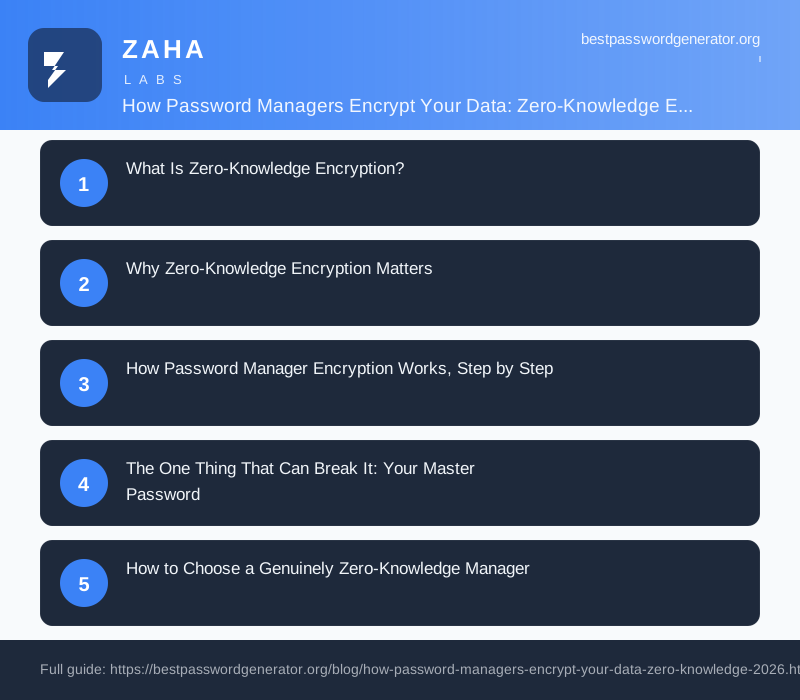
🔐 How Password Managers Encrypt Your Data: Zero-Knowledge Encryption Explained
The single biggest objection people have to password managers is understandable: “Why would I put all my passwords in one place?” It sounds like putting every valuable you own in one box. The answer lies in how that box is built. A modern password manager is not a filing cabinet with a lock — it is a vault that even the manufacturer cannot open. This guide explains, in plain English, exactly how that works in 2026, what the jargon on the marketing pages actually means, and what happens to your passwords if the provider itself gets hacked.
What Is Zero-Knowledge Encryption?
Zero-knowledge encryption is a security model in which your data is encrypted and decrypted only on your own device, using a key derived from a master password that the service never receives or stores. The provider holds nothing but encrypted ciphertext, so it has “zero knowledge” of what your vault actually contains. When you log in, your device proves it knows the password without ever transmitting it — the servers verify you without ever learning your secret.
This is the architectural difference between a password manager and, say, a note-taking app that happens to store passwords. In a normal cloud service, the company can read your data because it holds the decryption keys. In a zero-knowledge system, the company deliberately designs itself so it cannot, even if it wanted to, even under legal compulsion. The encryption happens client-side, before upload; the key lives only in your memory.
Why Zero-Knowledge Encryption Matters
Password managers are high-value targets precisely because they hold so much. That makes the question “what happens when the provider is breached?” not paranoid but essential. Zero-knowledge design answers it: a breach of the provider exposes encrypted vaults, not readable passwords. The attacker walks away with a locked safe and no combination.
This has been tested in the real world. When major password manager providers have suffered breaches, the stolen data consisted of encrypted vault blobs. Customers whose master passwords were long, unique, and random remained protected because the ciphertext could not be feasibly decrypted; the users most at risk were those with short, guessable master passwords, where attackers could attempt offline brute-force guessing. The lesson is consistent with the wider evidence on account takeovers: the encryption did its job — human-chosen weak master passwords are the failure point.
How Password Manager Encryption Works, Step by Step
Here is what actually happens between typing your master password and your logins appearing on screen. Every step below runs on your device.
- Key derivation. Your master password is never used directly as an encryption key. Instead
it is run through a deliberately slow key-derivation function (KDF) — such as
Argon2idorPBKDF2with a high iteration count — together with a unique random salt. This produces a strong encryption key and makes mass guessing enormously expensive for an attacker. - Encryption. That derived key encrypts your vault using a modern cipher — commonly
AES-256(a NIST-standardized algorithm) orXChaCha20, which NordPass uses. The result is ciphertext: an unreadable stream of bytes. - Sync. Only the ciphertext is uploaded and synced across your devices. The server stores the encrypted blob and never sees the plaintext or the key.
- Decryption. When you unlock the vault on another device, your master password re-derives the same key locally, and decryption happens in memory on that device. The moment you lock the vault or close the app, the key is gone.
| Term you will see | What it actually means | Why it matters to you |
|---|---|---|
| AES-256 | A 256-bit symmetric cipher standardized by NIST (FIPS 197). | Brute-forcing the key itself is computationally infeasible with any current or foreseeable hardware. |
| XChaCha20 | A modern stream cipher used by some managers (including NordPass). | Fast and secure on all devices, including phones without hardware AES acceleration. |
| Argon2id / PBKDF2 | Key-derivation functions that stretch your master password into a key. | Deliberately slow, so attackers cannot rapidly guess millions of master-password candidates. |
| Salt | A unique random value mixed into key derivation. | Ensures two people with the same password get different keys, defeating precomputed “rainbow table” attacks. |
| Zero-knowledge | Encryption/decryption happen only on your device. | The provider cannot read your vault, reset your master password, or hand your data to anyone. |
The One Thing That Can Break It: Your Master Password
Zero-knowledge encryption is only as strong as the key feeding it, and that key comes from your master password. Because the whole system relies on the provider not holding your key, there is usually no “forgot password” recovery — lose the master password and the vault is genuinely unrecoverable, for you and for everyone else. That is a feature, not a flaw, but it puts the responsibility on you to choose a master password that is both memorable and extremely hard to guess.
The right tool for the master password is a passphrase: five or six random words is easy to recall yet provides enough entropy to make offline guessing impractical, even against an attacker who has stolen your encrypted vault. Every other password in your life should then be a long, random string generated for you. You can create one instantly with our password generator, and a manager such as NordPass — which encrypts vaults with XChaCha20 on a zero-knowledge basis — will store and autofill them across your devices.
How to Choose a Genuinely Zero-Knowledge Manager
Not every product that stores passwords is built this way. Use this checklist to judge one before you trust it:
- Explicit zero-knowledge / end-to-end encryption claim. The provider should state plainly that encryption happens on your device and that it cannot access your data.
- Named, modern cipher. Look for AES-256 or XChaCha20 — not vague “bank-grade security” language with no algorithm named.
- Strong key derivation. Argon2id or PBKDF2 with a high iteration count, plus a per-user salt.
- Independent security audits. Reputable managers publish third-party audit results rather than simply asserting they are secure.
- Clear breach posture. The company should be able to explain what an attacker would get if its servers were breached — the honest answer is “encrypted blobs.”
Frequently Asked Questions
Can a password manager company see my passwords?
No. With a zero-knowledge, end-to-end-encrypted manager, your vault is encrypted on your device before it is uploaded, and the provider never receives your master password or the derived key. It stores only ciphertext, so employees, attackers, and courts alike see unreadable data.
What happens to my passwords if the password manager gets hacked?
A breach of a zero-knowledge provider exposes encrypted vaults, not readable passwords. As long as your master password is long, unique, and random, the stolen ciphertext cannot feasibly be decrypted. Users with weak master passwords are the exception, because attackers can attempt to guess those offline.
Is AES-256 encryption actually unbreakable?
AES-256 has no known practical attack that would let someone decrypt data without the key, and brute-forcing a 256-bit key is computationally infeasible with current or foreseeable technology. In practice, attackers do not try to break AES — they target weak master passwords or malware on your device instead.
What if I forget my master password?
Because a true zero-knowledge manager never stores your master password, there is usually no way to recover it, and the vault becomes permanently unreadable. This is the trade-off that makes the system secure. Choose a memorable passphrase and store an emergency recovery kit, if your provider offers one, somewhere physically safe.
What This Means
“Why put all my passwords in one place?” has a precise answer in 2026: because that place is a zero-knowledge vault whose contents are encrypted on your device with AES-256 or XChaCha20, keyed by a master password the provider never sees. A breach of the company yields ciphertext, not credentials. The security of the whole system rests on one thing you control — the strength of your master password — so make it a long passphrase, enable two-factor authentication, and let random generation handle everything else.
Done that way, a password manager is not a single point of failure but a single point of strength: it turns the impossible task of memorizing dozens of long, unique passwords into a solved problem, while keeping the keys where they belong — with you.